Marcus Aurelius · Epictetus · Seneca
How to practice Stoicism, every day.
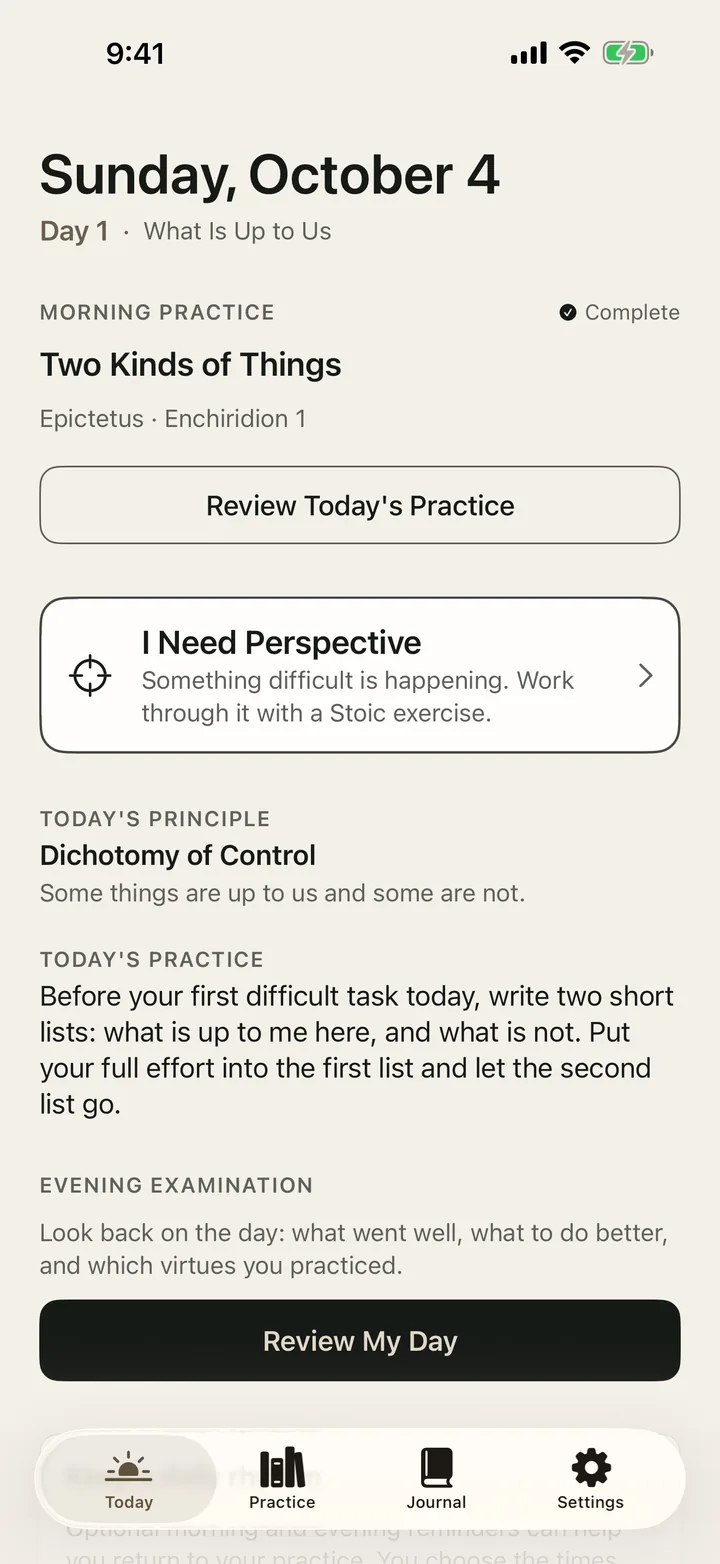
Practicing Stoicism means training your judgment every day, not only reading about it. Prepare in the morning, respond well when something goes wrong, examine the day at night, and repeat. Each step takes a few minutes, and today’s teaching is the place to start.
Of things some are in our power, and others are not. … Not in our power are the body, property, reputation, offices (magisterial power), and in a word, whatever are not our own acts. And the things in our power are by nature free, not subject to restraint or hindrance; but the things not in our power are weak, slavish, subject to restraint, in the power of others.
The Stoic day
How to practice Stoicism in four parts.
The method
Two moves everything rests on.
Every exercise on this site, and every part of the Stoic day, comes back to two habits from the opening of Epictetus’s handbook, the Enchiridion.
Sort what is up to you.
The handbook begins by dividing everything into two lists: what is in our power and what is not. Your judgments, your choices and your effort are on the first list. Your body, your property, your reputation and other people’s opinions are on the second, because they depend partly on things you don’t control. The practice is to notice which list a worry belongs to, then put your effort where it can do something.
Notice the judgment you add.
An event and your opinion about it arrive together, and they feel like one thing. Epictetus separates them: “Men are disturbed not by the things which happen, but by the opinions about the things.” A late reply is an event; “they don’t respect me” is a judgment. You can’t always change the first. You can always look again at the second.
Men are disturbed not by the things which happen, but by the opinions about the things; for example, death is nothing terrible, for if it were it would have seemed so to Socrates; for the opinion about death that it is terrible, is the terrible thing. When then we are impeded, or disturbed, or grieved, let us never blame others, but ourselves—that is, our opinions. It is the act of an ill-instructed man to blame others for his own bad condition; it is the act of one who has begun to be instructed, to lay the blame on himself; and of one whose instruction is completed, neither to blame another, nor himself.
I · Prepare · Morning
Begin with one teaching.
Seneca’s advice for the start of a day is blunt: “Think of everything, expect everything.” The rude driver, the late reply and the friend who lets you down are ordinary events, and anger feeds on surprise. A morning practice takes about two minutes: read one passage slowly and carry one sentence of it into the day.
Thus it is either ignorance or arrogance that makes us angry: ignorance of common facts; for what is there to wonder at in bad men committing evil deeds? … Think of everything, expect everything …
II · Respond · Midday
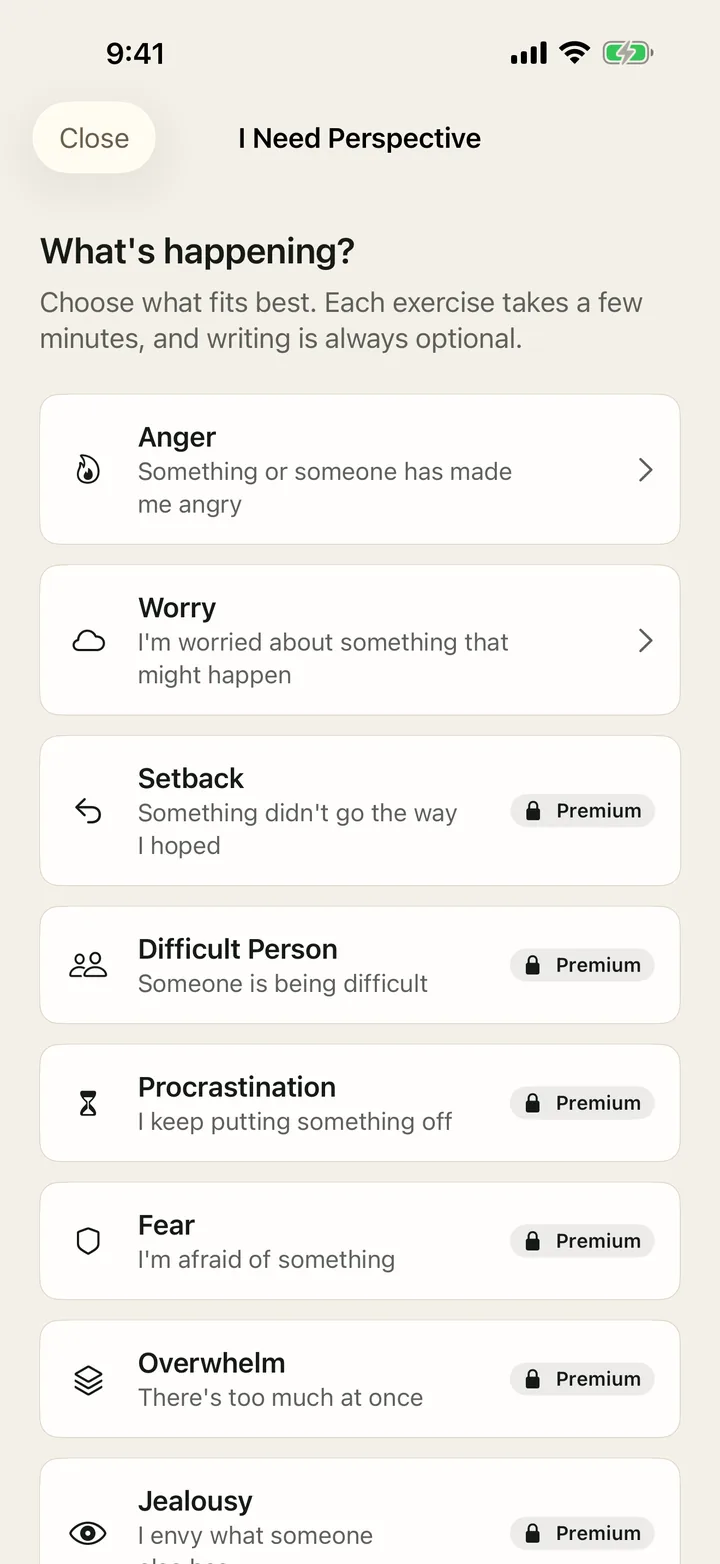
When it gets hard, get perspective.
Name what happened, sort what is up to you, and leave with one concrete next action.
Three free exercises
What’s happening?
Choose what fits best. Each exercise takes a few minutes, and writing is always optional.
- Anger
- Seneca’s first remedy for anger is delay, and the exercise builds it in: you write what happened, then what a camera would have recorded, then the story you added. After a passage from Epictetus you choose the virtue you want to act from and one thing to do next.
- Worry
- Epictetus asked anxious people what they wanted that was not in their power. The exercise separates what you actually know from what you are imagining, sorts what is up to you, and ends with one thing you can act on today.
- Outside My Control
- For something already done: say what is troubling you, sort what is involved into what is yours and what is not, read Epictetus’s first lesson, and choose one concrete next action for the part that is still yours.
Nine more in the app: Setback, Difficult Person, Procrastination, Fear, Overwhelm, Jealousy, Loss, Uncertainty and Difficult Decision. In the app
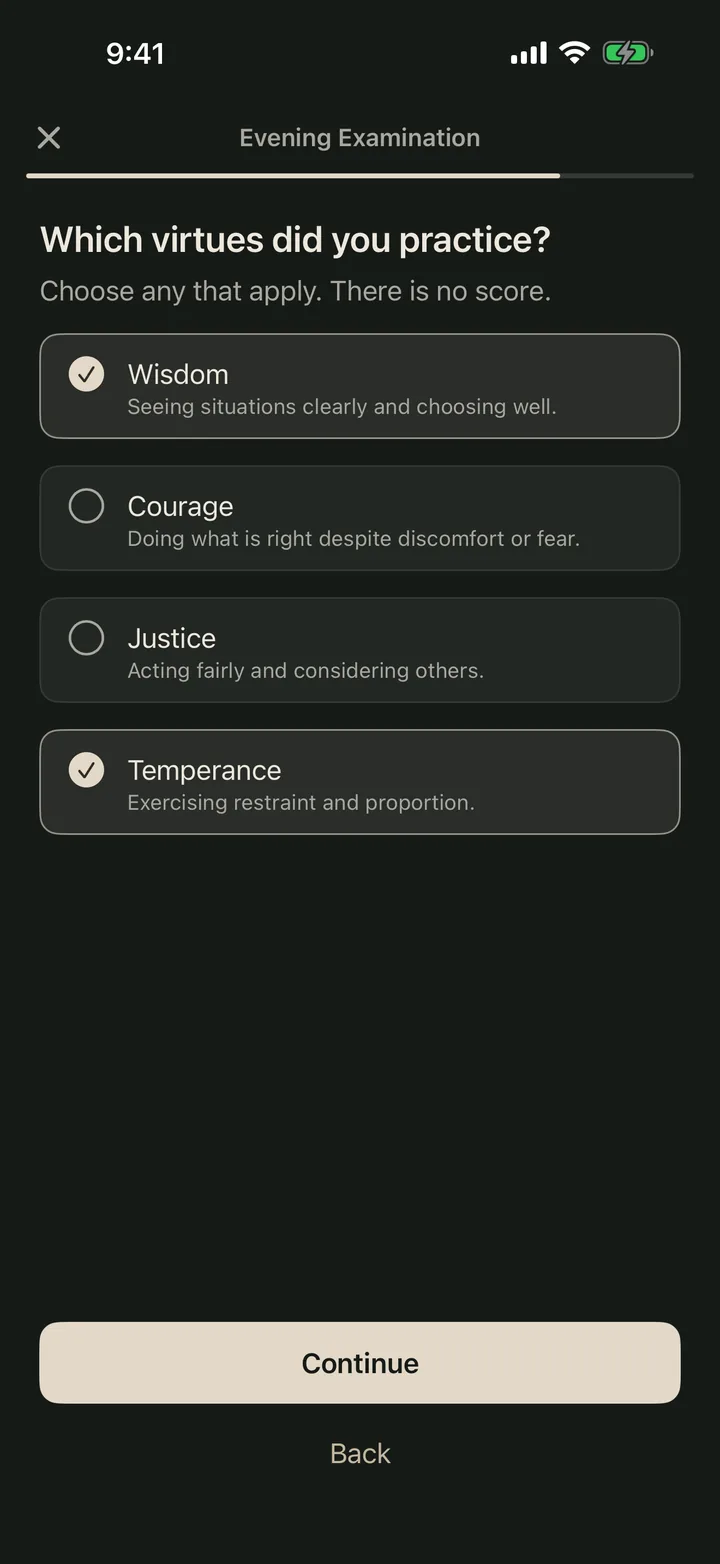
III · Examine · Evening
Close the day with a clear mind.
Seneca reviewed each day at night, once the lamp was out, hiding nothing from himself. The version here takes about five minutes: five questions, no score, and your answers stay in your browser.
- What did you do well today?
- Where could you have responded better?
- What did you allow to disturb you that was outside your control?
- Which virtues did you practice?
- Tomorrow I will…
I make use of this privilege, and daily plead my cause before myself: when the lamp is taken out of my sight, and my wife, who knows my habit, has ceased to talk, I pass the whole day in review before myself, and repeat all that I have said and done: I conceal nothing from myself, and omit nothing
IV · Repeat · Tomorrow
Then do it again tomorrow.
Epictetus treated a virtue like any other habit: “the habit of walking by walking, the habit of running by running.” Reading about patience doesn’t make you patient; meeting the next delay patiently does, and then the one after that.
He measured progress in days, not in perfection: angry every day, then every second day, then every third. That is a fair standard for anyone. Miss a morning, skip a night, and the practice is still there the next day. The principles behind it are short enough to keep in mind, and two of the classic practices are free to try here.
Every habit and faculty is maintained and increased by the corresponding actions: the habit of walking by walking, the habit of running by running. … Generally then if you would make anything a habit, do it; if you would not make it a habit, do not do it, but accustom yourself to do something else in place of it. … If then you wish not to be of an angry temper, do not feed the habit: throw nothing on it which will increase it: at first keep quiet, and count the days on which you have not been angry. I used to be in passion every day; now every second day; then every third, then every fourth.
Stoic Practice for iPhone
Practice philosophy. Don’t just read it.
Stoic Practice puts the whole day on your iPhone: the morning teaching at the time you choose, the exercises one tap from Today, and an evening examination that remembers what you resolved.
- 365 daily teachings in 13 units
- 12 guided exercises for hard moments
- 12 classic Stoic practices
- Your journal stays on your iPhone
The daily practice is free. Premium adds the full guided Morning Practice, all exercises and practices, and the archive: $6.99/month or $39.99/year (U.S.; prices vary by country). No trial, no ads, no account.
Where it gets tested
Practicing in the places that test you.
- At work and with difficult peopleGuideInsults, rudeness and the colleague who won’t change.
- With family and partnersGuideWhy Stoics are not emotionless, and what they did with feelings instead.
- Without the posturingGuideWhat the ancient Stoics taught, as opposed to “never show emotion.”
- As a complete beginnerGuideWhere to start, what to read and a first four weeks.
The library
Read the Stoics on practice.
daily teachings: 322 quoted word for word from public-domain translations, 43 labeled paraphrases.
The sources
Every quotation, traced to its text.
Lines credited to Marcus Aurelius online are often modern inventions or film dialogue. Here, every quotation is an exact excerpt of a public-domain translation, checked word for word by software against the digitized text, with its book, section and translator.
| Philosopher | Work | Translation | Year |
|---|---|---|---|
| Marcus Aurelius | Meditations | George Long | 1862 |
| Epictetus | Discourses, Enchiridion | George Long | 1877 |
| Seneca | On Anger, On the Shortness of Life and other dialogues | Aubrey Stewart | 1889 |
| Seneca | On Benefits | Aubrey Stewart | 1887 |